
Our History
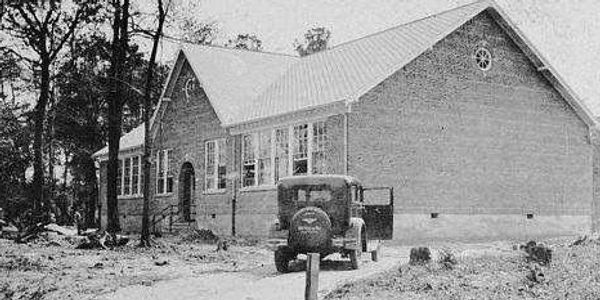
The Town of Cape Charles, Virginia is home to a remarkable piece of educational and community history: the historic Cape Charles Elementary, a Washington–Rosenwald School.
Known affectionately by its students as “the school over the hump” because of its location just beyond the former railroad bridge, the school opened in 1929 during the era of legalized segregation. Its creation was inspired by the groundbreaking partnership between education leader Booker T. Washington and philanthropist Julius Rosenwald, whose collaboration expanded educational opportunities for African-American children across the South through partial funding and standardized school building plans for more than 5,000 schools known collectively as “Rosenwald Schools.”
The only Rosenwald School built in Northampton County, the Cape Charles school reflects the unique historical context of the town and its Black community. African-American residents had established a strong foundation of Black education in Cape Charles for decades, and it was through their advocacy and sacrifice—combined with public support and philanthropic assistance—that this state-of-the-art brick schoolhouse was constructed to provide improved educational facilities and opportunities for their children.
The school cost $16,362 to build in 1928–1929. Designed to serve as a catalyst rather than a sole funder, the Rosenwald Fund required significant community participation and matching support. Funding for the Cape Charles school included $1,000 from the Rosenwald Fund, $2,000 from the Negro School League, $2,457 from the Town of Cape Charles, and a $10,905 loan from the Virginia Literary Fund.
The building’s design was an adaptation of the Rosenwald Fund’s Floor Plan No. 4 and incorporated advanced educational features for its time. The one-story brick structure included four classrooms, an auditorium, and administrative space, and was staffed by three teachers and a principal-teacher. It served students in grades one through seven and became an important center of learning and community life for African-American families in Cape Charles.
The school closed in 1966 following desegregation. In the years that followed, the property was repurposed as a seafood processing plant, which closed in 1977. The building then sat vacant for nearly half a century. Despite industrial modifications and decades of neglect, the structure retained a remarkable degree of historic integrity.
A grassroots initiative led by former alumni and community members was formed in 2009 to raise awareness of the school and document its rich history. By 2014, this effort had evolved into the 501(c)(3) nonprofit Cape Charles Rosenwald School Restoration Initiative, Inc. (CCRSRI).
In 2019, CCRSRI purchased the school and, as a volunteer-led organization, raised the funding and guided the restoration and repurposing of the building to serve the modern-day community. The building reopened to the public on January 19, 2026.
For more detailed and documented information on the history of this school, click the "Read the National Register Nomination" button below.
Cape Charles Elementary

The Rosenwald School in Cape Charles
A short film in partnership with WHRO Public Media
Hear from alumni who attended "Cape Charles Elementary", a Rosenwald School.
Shortly after the CCRSRI purchased the Historic Cape Charles Elementary - A Rosenwald School, Northampton County entrepreneur, Jahiem Fisher, hosts interviews in the school as alumni Valentine Evans, Thomas Godwin and Dianne Davis share the story of their beloved alma mater.
"African American History: The Rosenwald School in Cape Charles" eMediaVA.org. Version 4.0. eMediaVA, 1 Jul. 2022. Web. 11 Jun. 2023. <https://emediava.org/l/64429>
Oral History Interviews
Patricia Scott Beach
attended 1950-1958
Dianne Davis
attended 1955-1962
Charles Williams
attended 1957-1964
Voices From Over the Hump
WHRO's Another View speaks with alumni.
The Booklet
Invisible History of African Americans in Cape Charles - A Walking Tour
The Invisible History of African Americans in Cape Charles is a community service project of the Rotary Club of Cape Charles with support from Virginia Humanities and the Frances Bibbins Latimer Fund. The tour celebrates amazing stories and accomplishments of African Americans in Cape Charles. The Historic Cape Charles Elementary School - a Washington-Rosenwald School - is the final stop and capstone on the tour.